Are the medications you’re taking for heartburn and acid reflux increasing your fracture risk?
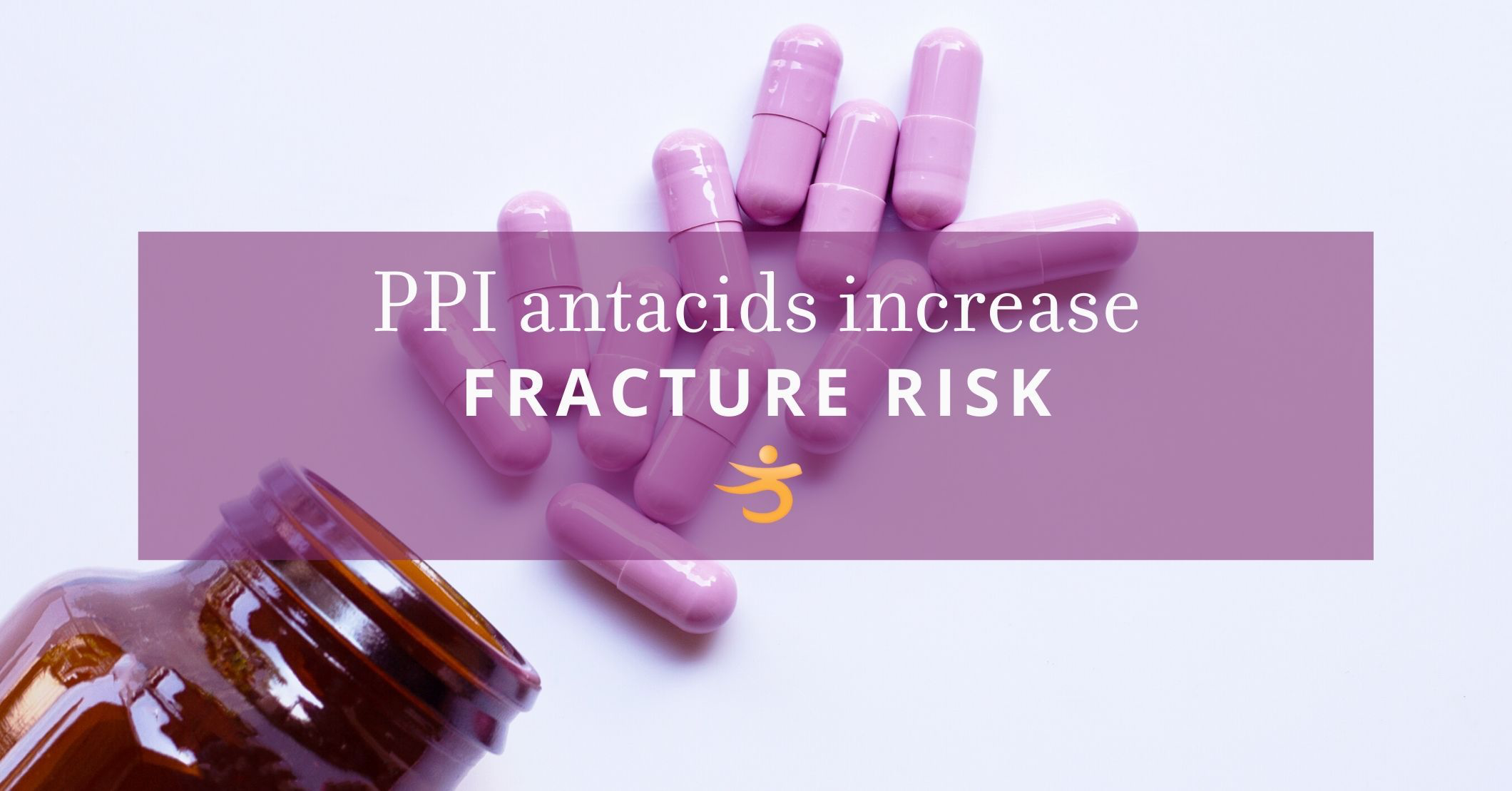
Proton pump inhibitor antacids (PPIs) like omeprazole (Prilosec), lansoprazole (Prevacid), esomeprazole (Nexium) and others can seriously increase your risk of fracture 30 to 50% — and even up to 200% according to one study. In fact, the risk is so great the FDA issued a warning about it.
What’s more, this class of medications is among the most overprescribed drugs (as well as being available over the counter), and it is estimated that up to 70% of people taking them don’t really need them.
What’s the problem with proton pump inhibitor antacids?
One likely reason for the problems with the PPIs is that inhibition of stomach acid means less nutrient absorption and therefore reduced bone strength. The effects of PPIs on nutrient absorption is well-documented and affects calcium, iron, magnesium, B12, and other key bone nutrients.
Nutrient depletion in turn leads to lower trabecular bone density and susceptibility to low-impact fracture.
Recent research shows other serious damaging effects
- 50% increase in risk of chronic kidney disease
- 58% increase in risk of heart attack
- 44% increased risk of developing dementia, including Alzheimer’s in people age 75 and older
- A significant increase in serious gastrointestinal infections such as difficile.
Symptom suppression often leads to dysregulation of the entire body; that’s why the Better Bones, Better Body approach takes the perspective that identifying and correcting the root cause of a symptom is a more life-supporting approach.
PS: In the attached video, I interview my colleague, nutritionist Martie Whittekin, CCN, author of Natural Alternatives to Nexium, Maalox, Tagamet, Prilosec, and Other Acid Blockers. While this is a serious topic, the interview is fun and informative and well worth watching.
References:
Andersen BN, Johansen PB, Abrahamsen B. Proton pump inhibitors and osteoporosis. Curr. Opin. Rheumatol. 28(4):420–425, 2016.
Forgacs I, Loganayagam A. Overprescribing proton pump inhibitors. BMJ, 336(7634):2–3, 2008.
Gomm W, von Holt K, Thomé F, et al. Association of proton pump inhibitors with risk of dementia: A pharmacoepidemiological claims database analysis. JAMA Neurol. 73(4): 410–416, 2016.
Ito T, Jensen RT. Association of long-term proton pump inhibitor therapy with bone fractures and effects on absorption of calcium, vitamin B12, iron and magnesium. Curr. Gastroenterol.Rep. 12(6):448–457, 2010.
Wei L, Ratnayake L, Phillips G, et al. Acid suppression medications and bacterial gastroenteritis: a population-based study cohort. Br. J. Clin. Pharmacol., 2016 DOI: 10.1111/bcp.13205.
Maggio M, Lauretani F, Ceda GP, et al. Use of proton pump inhibitors is associated with lower trabecular bone density in older individuals. Bone, 57(2):437–442, 2013.
Moberg LM, Nilsson PM, Samsioe G, Borgfeldt C. Use of proton pump inhibitors (PPI) and history of earlier fracture are independent risk factors for the fracture in postmenopausal women. The WHILA study. Maturitas, 78(4): 310–315, 2014.
Schoenfeld AJ, Grady D. Adverse effects associated with proton pump inhibitors. JAMA Intern. Med., 176(2):172–174, 2016.
Shih CJ, Chen YT, Ou DM, et al. Proton pump inhibitor use represents an independent risk factor for myocardial infarction. Int. Cardiol., 177(1):292–297, 2014.
Whittekin M. Natural Alternatives to Nexium, Maalox, Tagamet, Prilosec and other Acid Blockers. Square One Publishers, Garden City Park, New York, 2012.
Zhou B, Huang Y, Li H, Sun W, Liu J. Proton pump inhibitors and risk of fracture; an update meta-analysis. Osteoporosis Int., 27(1):339–347, 2016.
Explore the full research on this in our resource on how pH balance protects your bones.