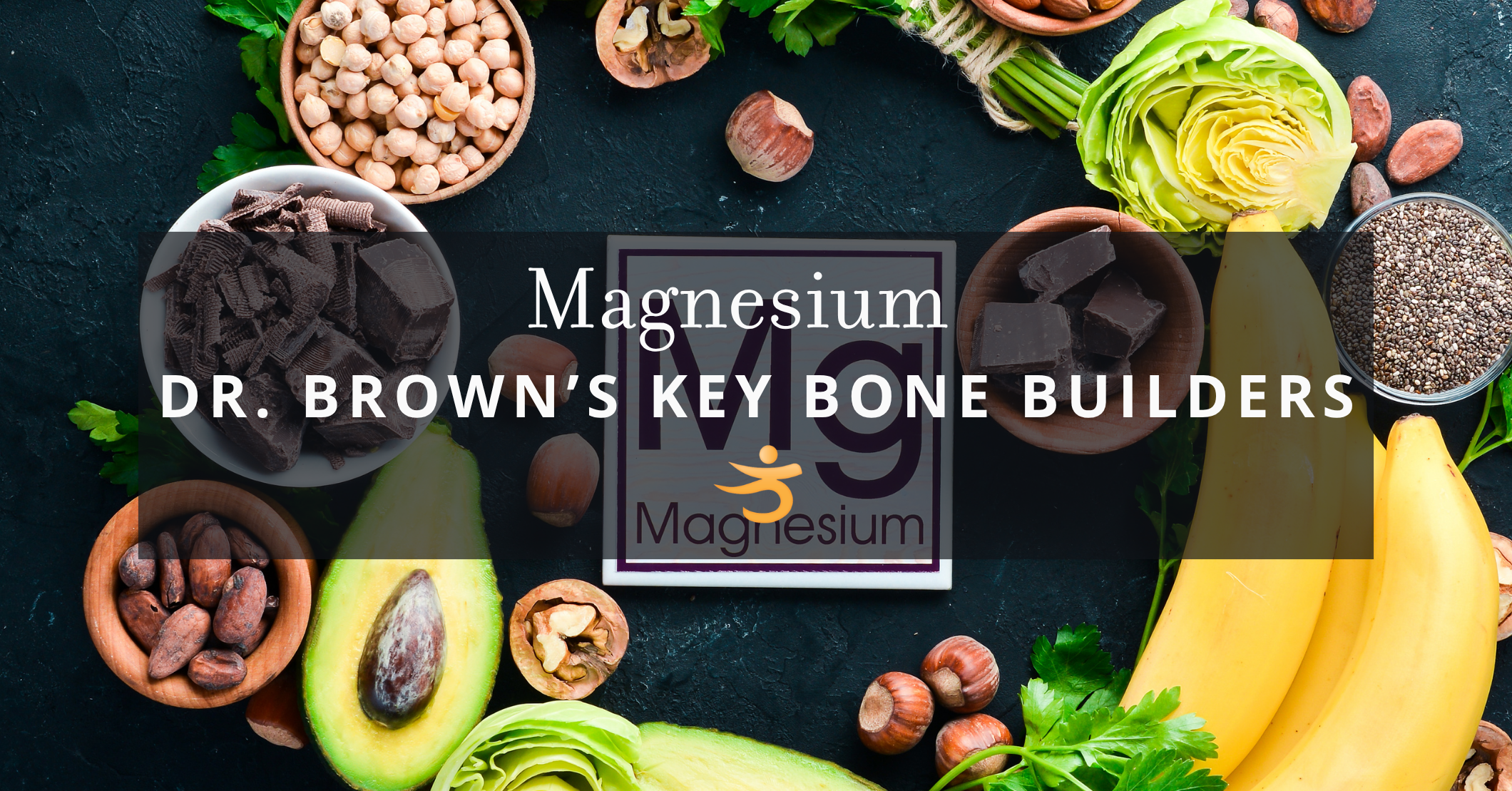
If you’re searching for the best magnesium for osteoporosis, you’re already ahead of most of the conversation about bone health. While calcium gets nearly all of the spotlight, magnesium is arguably the more commonly deficient — and more frequently overlooked — structural mineral for building and preserving bone. Without enough magnesium, calcium can’t be properly absorbed, can’t be directed into bone, and can even end up calcifying the arteries, kidneys, and joints instead.
Magnesium Is a Structural Bone Builder — The “Concrete and Bricks” of Your Skeleton
In Dr. Susan Brown’s framework of 20 Key Bone-Building Nutrients, magnesium belongs to the first and most foundational category: the Structural Bone Builders. These are the nutrients that physically make up your bones — the “concrete and bricks” of your skeleton.
If bone is a house, the Structural Bone Builders are the raw materials the house is actually built out of. About 50–60% of bone is mineral, and together with calcium and phosphorus, magnesium influences bone crystal formation and contributes to the flexibility and structural integrity of bone tissue. Roughly 60% of the body’s magnesium is stored in bone, where it serves as both a structural component and a reservoir that the rest of the body draws from in times of need.
Without enough magnesium, the bone-mineral crystal forms incorrectly — often producing bone that is denser but more brittle. This is one of the reasons Dr. Brown considers magnesium a non-negotiable structural nutrient in her complete bone-building protocol.
Therapeutic range: 500–1,000 mg daily.
What Magnesium Actually Does for Your Bones
Overall, magnesium assures the strength and firmness of bones and makes teeth harder. Since magnesium participates in an astonishing array of biochemical reactions, it’s no surprise that it’s essential for healthy bones and teeth. Most notably, adequate magnesium is essential for absorption and metabolism of calcium.
Magnesium also has a role to play, together with the thyroid and parathyroid glands, in supporting bone health: stimulating the thyroid’s production of calcitonin, which acts as a bone-preserving hormone, and regulating parathyroid hormone, a function of which is to regulate bone breakdown in a number of ways.
Magnesium is an essential cofactor in 80% of all cellular enzymes. It is necessary for the conversion of vitamin D into its active form, and a deficiency of magnesium can lead to a syndrome known as vitamin D resistance . The enzyme required for forming new calcium crystals, alkaline phosphatase, also requires magnesium for activation, and if levels are low, abnormal bone crystal formation can result. Even mild magnesium deficiency is reported to be a leading risk factor for osteoporosis.
Why Magnesium Is the Most Commonly Deficient Bone Mineral
There has been conflicting opinion about the adequacy of our magnesium intake — but the data is actually pretty clear. Despite its recognized importance, most Americans consume less than the Estimated Average Requirement (EAR) for magnesium. As of 2001, 56% of the US population was not consuming the EAR for this mineral, and more recent analyses suggest the gap has only widened. Factors that deplete magnesium include modern soil depletion, processed food consumption, chronic stress, high caffeine or alcohol intake, and many common medications — including proton pump inhibitors and some diuretics.
As with calcium, the majority of the body’s reserves of magnesium are held in the bone (about 60%), and the bones act as a storage reservoir, transferring magnesium into the blood stream in times of need. Adequate daily intake of magnesium is important throughout life to keep the magnesium that is stored in the bones from being lost. Low magnesium intake, as well as low blood and bone magnesium levels, has been widely associated with osteoporosis in women.
Calcium Without Magnesium Can Actually Hurt Your Bones
It’s often overlooked that magnesium and calcium function together, so deficiency of one markedly affects the metabolism of the other. In fact, increasing calcium supplementation without increasing magnesium supplementation can actually increase magnesium loss. Similarly, the use of calcium supplements in the face of a magnesium deficiency can lead to calcium deposition in the soft tissues, such as the joints, where it can promote arthritis, or in the kidneys, contributing to kidney stones.
This is why Dr. Brown never recommends calcium supplementation without a properly balanced magnesium partner. As a rule of thumb, she recommends at least half as much magnesium as calcium (a 1:2 ratio of magnesium to calcium), and in most cases she prefers nearly as much magnesium as calcium. People with osteoarthritis, in particular, want to use equal amounts of magnesium and calcium.
What Is the Best Form of Magnesium for Osteoporosis?
Not all magnesium supplements are equally bioavailable or bone-friendly. When choosing the best magnesium for osteoporosis, look for highly absorbable, well-tolerated forms:
- Magnesium glycinate (bisglycinate) — highly bioavailable, gentle on the digestive system, and ideal for people with sensitive stomachs or sleep issues.
- Magnesium citrate — well absorbed and mildly alkalizing; a solid everyday choice for bone support.
- Magnesium malate — well absorbed and helpful for people with fatigue or muscle tenderness.
- Ionized magnesium — a highly bioavailable, pre-dissolved form that supports rapid absorption.
- Magnesium oxide — inexpensive but poorly absorbed; often causes loose stools. Generally Dr. Brown’s last choice for bone support.
For most women, a daily intake of 500–1,000 mg of elemental magnesium from food plus supplements — divided into two or three doses — best supports calcium absorption, vitamin D activation, and bone crystal formation (NIH ODS Magnesium Fact Sheet).
Best Food Sources of Magnesium for Bone Health
- Dark leafy greens (spinach, Swiss chard, kale)
- Pumpkin and sunflower seeds
- Almonds, cashews, and Brazil nuts
- Avocado
- Black beans, edamame, and other legumes
- Dark chocolate (70%+ cacao)
- Wild-caught salmon and mackerel
- Whole grains such as quinoa, buckwheat, and oats
Because modern soils are frequently magnesium-depleted, even a clean whole-food diet often doesn’t provide enough for someone actively rebuilding bone — which is why Dr. Brown typically recommends smart supplementation alongside food.
Testing Your Magnesium Status — First-Morning Urine pH
Because most magnesium is stored in bone and muscle (not blood), standard serum magnesium tests often miss early deficiency. Dr. Brown has long recommended a simple at-home marker: first-morning urine pH. Persistently acidic first-morning urine (below 6.5) is often a sign that the body is pulling alkalizing minerals — including magnesium — out of bone to buffer dietary acid load. Tracking this marker over time is one of the easiest ways to see whether your magnesium and mineral reserves are being supported or quietly depleted.
Shop Dr. Brown’s Complete Bone Supplement Guide
Balancing magnesium with calcium, vitamin D, vitamin K2, and the other Structural Bone Builders can feel overwhelming. Dr. Brown has created a complete, practical shopping guide that walks you through exactly which magnesium formulas and mineral combinations she recommends for osteopenia, osteoporosis, and long-term bone maintenance — already balanced in the ratios your bones need.
Ready to Choose the Best Magnesium for Your Bones?
Get Dr. Brown’s Complete Bone Supplement Guide — her step-by-step recommendations for magnesium and all 20 key bone-building nutrients.
Magnesium Is Just One Piece — Learn Dr. Brown’s Complete 6-Step Bone System
Magnesium balance is critical, but it’s only one piece of a much bigger picture. True, lasting bone strength requires all 20 key nutrients plus alkaline balance, healthy digestion, targeted exercise, hormone support, and the removal of bone-depleting lifestyle factors.
Inside the Better Bones Solution, Dr. Susan Brown teaches her complete 6-step protocol for building and maintaining lifelong strong bones — the same science-backed system she has used with thousands of women to rebuild bone naturally and avoid fractures, without relying solely on drugs.
Take Dr. Brown’s Better Bones Solution Course
Learn Dr. Susan Brown’s 6-step protocol for lifelong strong bones — the proven, natural approach for preventing and reversing bone loss.
Bone Health Goals Inquiry
Let us know which supplements interest you and a little about your current routine. A member of our team will reach out to help you build a personalized plan.
Bone Health Goals Inquiry
Let us know which supplements interest you and a little about your current routine. A member of our team will reach out to help you build a personalized plan.
Related Reading From Better Bones
- The 20 Key Bone-Building Nutrients — Complete Overview
- Best Calcium for Osteoporosis
- Phosphorus and the Calcium-Phosphorus Balance
- Vitamin D and Mineral Absorption
- Vitamin K2 — Directing Minerals Into Bone
- Why Dr. Brown Tests First-Morning Urine pH
- Dr. Brown’s Natural Approach to Bone Health
- Science-Backed Supplements for Stronger Bones
Scientific References
- Castiglioni S, Cazzaniga A, Albisetti W, Maier JA. Magnesium and osteoporosis: current state of knowledge and future research directions. Nutrients. 2013. PubMed
- Uwitonze AM, Razzaque MS. Role of Magnesium in Vitamin D Activation and Function. J Am Osteopath Assoc. 2018. PubMed
- DiNicolantonio JJ, O’Keefe JH, Wilson W. Subclinical magnesium deficiency: a principal driver of cardiovascular disease and a public health crisis. Open Heart. 2018. PubMed
- Rude RK, Singer FR, Gruber HE. Skeletal and hormonal effects of magnesium deficiency. Magnes Res. 2009. PubMed
- National Institutes of Health, Office of Dietary Supplements. Magnesium Fact Sheet for Health Professionals. ods.od.nih.gov
- Perspective: The Case for an Evidence-Based Reference Interval for Serum Magnesium: The Time Has Come PubMed