If you’re looking for the best vitamin C for osteoporosis, you’re on the right track. While most bone-health conversations focus on calcium, vitamin C is the nutrient that actually lets your body build bone in the first place. Without it, the collagen scaffold that holds your skeleton together simply cannot form properly — which is why scurvy (severe vitamin C deficiency) causes teeth to fall out and bones to become fragile.
In this guide, Dr. Susan Brown — author of Better Bones, Better Body and developer of the Better Bones Solution — explains exactly what vitamin C does for your bones, which form to take, how much you really need, and why getting it right matters more as you age.
Vitamin C Is a Collagen Matrix Builder — The “Carpenter” of Your Skeleton
In Dr. Brown’s 20 Key Bone-Building Nutrients framework, nutrients work together across four cooperating systems. Vitamin C belongs to the Collagen Matrix Builders — the crew that builds and weaves the flexible protein scaffolding that gives bone its tensile strength and fracture resistance.
Think of your bone as a house. Calcium and phosphorus are the bricks and concrete. Protein and collagen are the lumber. But even the finest lumber doesn’t become a house by itself — you need a carpenter to frame it, join it, and hold it square. Vitamin C is that carpenter. It is required for the enzymes (prolyl and lysyl hydroxylase) that cross-link collagen fibers into strong, stable triple-helix rope. Without adequate vitamin C, new collagen is weak, disorganized, and cannot support mineralization.
Dr. Brown’s therapeutic target for vitamin C is 3,000–4,500 mg per day for women actively working to recover or preserve bone health — dramatically higher than the federal RDA of 75 mg for women, which was set to prevent scurvy, not to build optimal bone.
Three Ways Vitamin C Is Essential for Healthy Bones
Vitamin C is involved in a great variety of complex and interrelated metabolic processes. Here are three ways in which it is essential for healthy bones.
- Vitamin C assists in the formation of collagen. As described in our article on the nature of healthy bones, bone mineral is laid down over a protein matrix called collagen. Collagen is abundant in the connective tissue of cartilage and bone — in fact, by volume it makes up about 40% of our bones, serving as a support structure for mineral deposits and giving bone its resilience.
- Vitamin C stimulates bone-building cells. In addition to its role in collagen formation, vitamin C appears to stimulate the cells that build bone (osteoblasts), enhance calcium absorption, and enhance vitamin D‘s effect on bone metabolism.
- Vitamin C supports adrenal hormones that protect bone. A third role for vitamin C and bones is in the synthesis and optimal functioning of adrenal steroid hormones, which play a vital role in bone health — especially during perimenopause and menopause, when ovarian production of these hormones slows.
Even though the RDA‘s for vitamin C are a very minimal 90 mg for men and 75 mg for women, great numbers of Americans do not even consume this amount. Many well-qualified scientists, including the late Nobel laureate Linus Pauling, believe recommended levels are extremely low and that our health would be greatly served by a much higher intake per day. At the Center for Better Bones, patients are encouraged to strive for an intake of 3,000–4,500 mg per day to recover and preserve bone health, and more if individual need is determined.
Best Vitamin C for Osteoporosis: Which Form Should You Take?
Not all vitamin C supplements are created equal — and for bone health specifically, form and delivery really do matter. Here is how Dr. Brown ranks them.
1.Buffered Mineral Ascorbates (Dr. Brown’s Top Choice For Potency)
At the higher therapeutic doses Dr. Brown recommends, buffered mineral ascorbates — calcium ascorbate, magnesium ascorbate, potassium ascorbate, sodium ascorbate — are the best choice. They deliver a meaningful dose of vitamin C without the acidifying effect of plain ascorbic acid, which can actually work against alkaline bone chemistry when taken in grams per day.
2. Liposomal Vitamin C
Liposomal formulations encase vitamin C in a phospholipid bubble, dramatically increasing absorption and blood levels. While well absorbed these supplements deliver lower than desired levels of Vitamin C, are much more expensive, and do not contribute minerals or alkalize the chemistry as does the Vitamin C delivered in the ascorbate form.
3. Whole-Food Vitamin C Complex
Whole-food sources (acerola cherry, camu camu, amla, rose hips) deliver vitamin C alongside the natural bioflavonoids, tyrosinase, rutin, and other cofactors that your body evolved to use with ascorbic acid. While natural the bio availibilty is lower with food sourced supplements. Today due to excessive environmental pollutants and toxins best results are seen with high dose ascorbate Vitamin C.
What to avoid
Very high doses of plain ascorbic acid on an empty stomach can be acidifying, irritate the gut, and loosen stools — generally not ideal if you are eating an alkaline bone-building diet.
How Much Vitamin C Do You Need for Strong Bones?
Dosing depends on your stage of life and goals:
- Baseline wellness: 1500–2,000 mg/day
- Active bone-building / postmenopausal women: 3,000–4,500 mg/day, split into 2–3 doses with meals
- Chemical Sensitivities: 5,000-10,000 mg/day
- During illness, stress, or active healing: Temporarily higher doses may be warranted under practitioner guidance (vitamin C demand rises sharply during stress and infection)
How to take it: Split your dose throughout the day — vitamin C is water-soluble and excreted relatively quickly, so 500–1,000 mg two or three times daily is far more effective than one big dose. For example 1/4 to 1/2 tsp of our Alkalini-C powder taken 2 or 3 times daily is far more effective than one big dose. Always take with food at the higher end of the range to avoid a flush.
Get the Right Vitamin C — and the Co-Factors It Works With
Dr. Brown’s Complete Bone Supplement Guide walks you through the exact vitamin C forms, doses, and partner nutrients she recommends for building and protecting bone after 50.
Best Food Sources of Vitamin C
Food first, always — then add supplements to fill the gap between what you eat and your therapeutic target.
- Acerola cherry — by far the most concentrated natural source (roughly 1,600 mg per 100 g)
- Camu camu and amla (Indian gooseberry) — available as powders you can stir into smoothies
- Rose hips — excellent as a tea or in jam
- Red and yellow bell peppers — about 190 mg per cup raw
- Kiwi, strawberries, papaya, oranges, grapefruit
- Broccoli, Brussels sprouts, kale, and parsley — bonus: these are also alkalizing and rich in vitamin K
Eat vitamin C foods raw or lightly cooked whenever possible — heat, light, and long storage all degrade the vitamin.
Vitamin C Works Best With Its Partner Nutrients
Because vitamin C is the carpenter of the Collagen Matrix Builders, it works hand-in-hand with the other members of that crew:
- Zinc — needed for collagen synthesis and osteoblast function
- Copper — cofactor for lysyl oxidase, which creates mature collagen cross-links
- Manganese — required for proteoglycan synthesis in the matrix
- Silicon (silica) — helps bridge the collagen-mineralization interface
- Protein and collagen peptides — the raw material vitamin C helps assemble
Taking vitamin C alongside a collagen peptide dose before weight-bearing exercise may give an extra boost to collagen synthesis in bone and connective tissue.
Putting It All Together
Vitamin C is one of the most powerful — and most under-dosed — nutrients for bone health. Getting 2,000–3,000 mg per day from the right forms, paired with the rest of the Collagen Matrix Builders and the full Better Bones program, is one of the simplest, safest, and most effective things you can do to protect and rebuild your skeleton.
Compare all the options in our comprehensive resource on which supplements actually help bone density.
Ready to Build Stronger Bones — for Life?
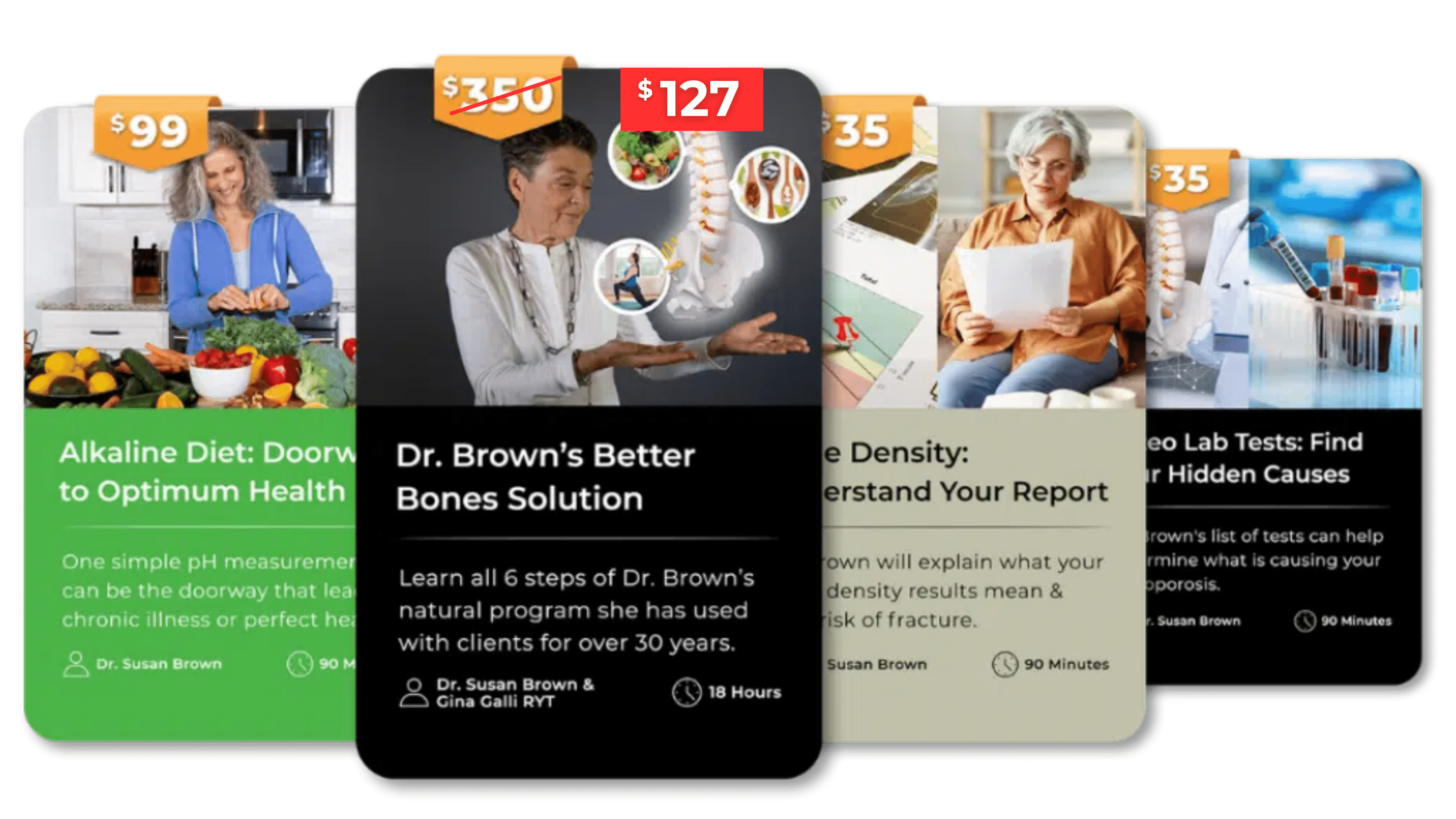
Dr. Brown’s Better Bones Solution teaches her complete 6-step protocol for lifelong strong bones — the same program she has used with thousands of women to stop bone loss and build new bone naturally.
Related Reading From Better Bones
- The 20 Key Bone-Building Nutrients: Complete Overview
- Best Collagen for Osteoporosis: Dr. Brown’s Complete Guide
- Best Protein for Osteoporosis
- Best Calcium for Osteoporosis
- Best Magnesium for Osteoporosis
- Vitamin D for Bone Health
- A Path to Better Bone Health for a Better Body
- Which Supplements Actually Help Bone Density?
- Better Bones Basics: Where to Start
Scientific References
- Sahni S, Hannan MT, Gagnon D, et al. Protective effect of total and supplemental vitamin C intake on the risk of hip fracture — a 17-year follow-up from the Framingham Osteoporosis Study. Osteoporos Int. 2009;20(11):1853-1861. PubMed
- Malmir H, Shab-Bidar S, Djafarian K. Vitamin C intake in relation to bone mineral density and risk of hip fracture and osteoporosis: a systematic review and meta-analysis of observational studies. Br J Nutr. 2018;119(8):847-858. PubMed
- Aghajanian P, Hall S, Wongworawat MD, Mohan S. The Roles and Mechanisms of Actions of Vitamin C in Bone: New Developments. J Bone Miner Res. 2015;30(11):1945-1955. PubMed
- Shaw G, Lee-Barthel A, Ross ML, Wang B, Baar K. Vitamin C–enriched gelatin supplementation before intermittent activity augments collagen synthesis. Am J Clin Nutr. 2017;105(1):136-143. PubMed
- National Institutes of Health, Office of Dietary Supplements. Vitamin C — Health Professional Fact Sheet. ods.od.nih.gov