Our skeletons were meant to last a lifetime, so when they show signs of not living up to this promise, we need to stop and ask ourselves, “What’s causing bones to weaken?”
Seems only logical, right?
While this is how thoughtful osteoporosis treatment begins, having spoken with thousands of individuals diagnosed with osteoporosis, I can’t help but notice a glaring difference between how women and men are treated when a bone health concern arises.
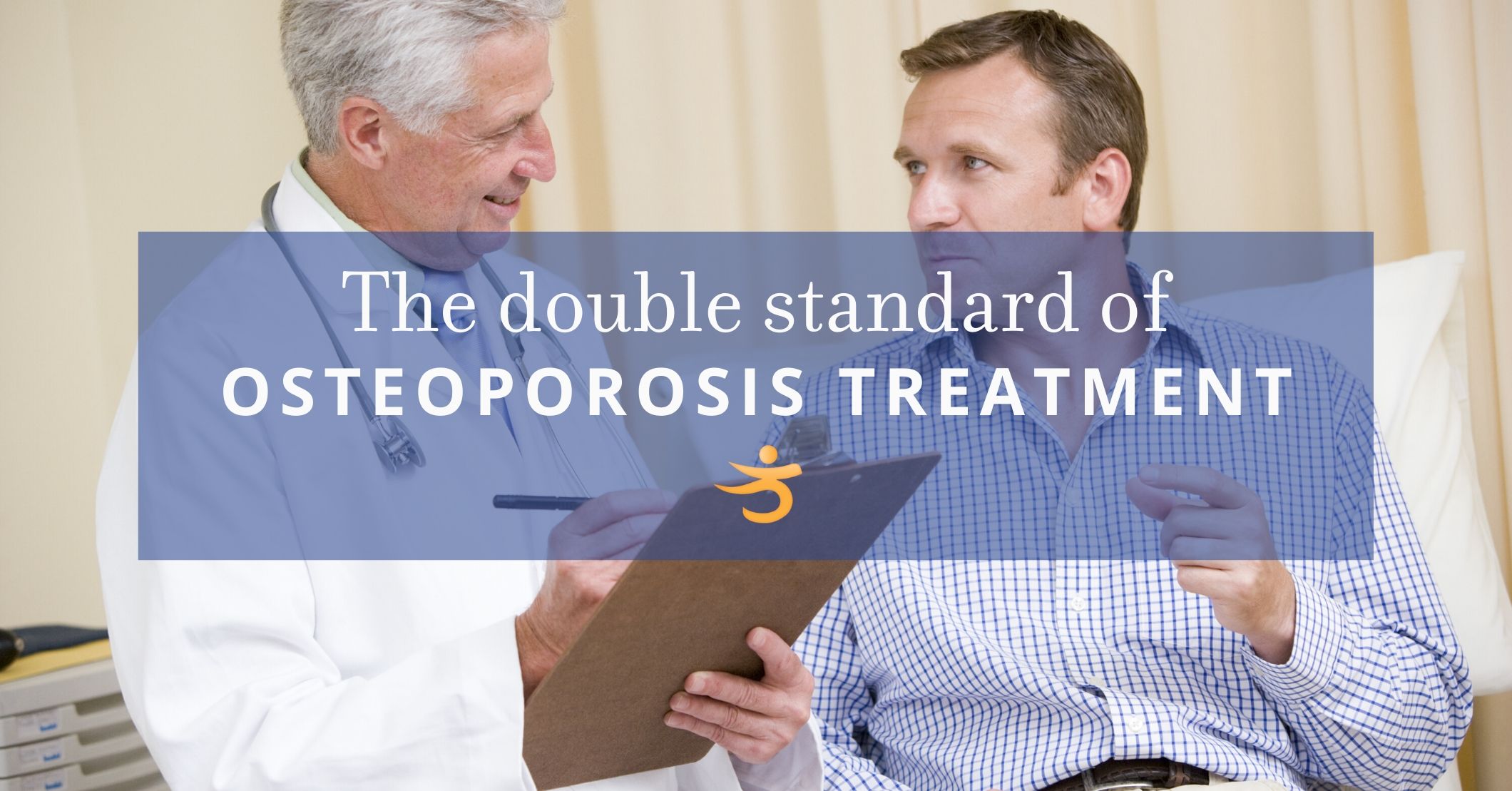
The double standard of conventional osteoporosis treatment
As a rule, women are told to take bone drugs when their T scores get to -2.5 or greater — without any investigation into the possible causes of their bone weakening. Often, they’re not even carefully questioned about their history, or even given a simple test for vitamin D adequacy. For a man with similar bone density or fracture history, however, a medical workup is usually ordered; he’s not simply handed a bone drug script.
Let me illustrate these statements with the cases of Sally and Robert.
Sally, a 61-year-old woman, experienced a spinal compression fracture and was found to have low bone density. Her hip and spine T-scores were -2.5 and -2.7, so she was diagnosed with osteoporosis. The doctor felt Sally’s osteoporosis was potentially dangerous, so he recommended bone drugs, despite all their limitations and unwanted side effects, as treatment. His recommendation was accompanied by remarks like, “You’ll fracture if you don’t.” When Sally expressed doubts, she heard, “You’ll end up disabled.”
At the Center for Better Bones, we take the position that if the doctor thinks the problem is serious enough to warrant bone drug use, then it is surely serious enough to warrant a search for the causes of this problem. Yet Sally wasn’t given even one of the medical tests commonly used to identify causes of bone weakening. She was simply and forcefully told to take bone drugs.
Richard, a slender, 55 year-old man with T-scores of of -3 in the hip and -2.5 in the spine, had no fractures. Like Sally, Richard was diagnosed with osteoporosis and offered bone drugs — but beforehand, he was subjected to one of the most comprehensive osteoporosis workups I’ve ever seen. He was tested for vitamin D, parathyroid hormone, loss of calcium in the urine, blood calcium, bone formation markers, celiac disease, autoimmune factors, a hormone panel, comprehensive nutrition testing — even tests looking for unusual bone marrow disorders. The irony is, men in his family have a tendency to have low bone mass, yet none ever had a significant osteoporotic fracture — so he was given this battery of tests (and offered drugs) despite personal and familial history suggesting his fracture risk was low.
While these are just two cases, this is something I typically see in my clients: women are rarely given the same sort of medical workup for osteoporosis as men, even when (as in Sally’s case) they have already had an osteoporotic fracture.
Finding hidden causes of osteoporosis
Of course, we should all review and correct any shortcomings in diet, lifestyle, exercise, behavior, and even thought patterns that contribute to less-than-ideal bone health. But if you have excessive bone loss or low-trauma fracture, women especially should seek out a physician who will look for underlying medical causes of bone weakness. As a guide, you might print out my list of osteoporosis workup medical tests to give your doctor. Follow this up by politely asking to be treated… like a man.
For a complete guide to rebuilding bone naturally, see our resource on natural osteoporosis support and bone rebuilding.
For natural support alongside any treatment, read our complete guide to bone health nutrition as a natural foundation.