Taken together, the weighted vest osteoporosis study research of the past 25 years points to one underlying principle: bone responds to mechanical challenge. In this article I review the key research, from the remarkable five-year study of postmenopausal women to the 2025 JAMA trial that made headlines and a new 2026 meta-analysis, and explain how to use a weighted vest safely and effectively, restoring the lost conversation between movement and the skeleton.
Key Takeaways
- Bone is mechanosensitive. It strengthens in response to the load placed upon it, and a weighted vest increases that load during everyday movement.
- Movement matters more than hours worn. Passive vest wear (3–5% of body weight, two hours a day, no exercise) produced no measurable benefit. Vests combined with purposeful exercise did.
- The five-year Snow study: postmenopausal women using weighted vests plus jumping maintained hip bone density, while controls lost 3.8–4.4%.
- The 2025 INVEST trial found vests did not prevent bone loss during 10% intentional weight loss, but neither did resistance training. It tested a different question than whether vests help weight-stable women.
- A 2026 meta-analysis of nine randomized trials (368 adults) found weighted-vest exercise improved femoral-neck and lumbar-spine BMD compared with usual activity.
- No single weighted vest osteoporosis study is definitive, but together the evidence is encouraging.
- Start at about 5% of body weight or less, progress gradually toward 10%, and use a snug, well-fitted vest.
For most of human history, our skeletons were exposed to something modern life has greatly reduced: regular mechanical challenge.
We walked farther, carried food and children, lifted objects, climbed, squatted, worked with our hands, and moved over uneven ground. With every step and every load, muscles pulled on bone and gravity pressed through the skeleton. These forces were not simply wear and tear. They were information.
Bone is living, sensing tissue. It continually detects mechanical strain and adapts its structure in response. When mechanical loading is sufficient, bone receives a signal that says, in effect, “This structure is needed. Maintain it. Strengthen it.” When loading diminishes, the message changes.
This is one reason I have become increasingly interested in a remarkably simple tool for healthy aging: the weighted vest. (If you are new to the topic, you may enjoy my earlier article, Why a Weighted Vest Is a Game-Changer for Bone Health.)
A weighted vest does not replace exercise. Instead, it can amplify something the skeleton has always depended upon—the mechanical conversation between movement, muscle, gravity, and bone.
Bone Is a Mechanosensitive Organ
Bone is sometimes described as though it were simply a mineral warehouse. In reality, it is a highly responsive sensory organ.
Bone cells—particularly osteocytes embedded within the mineralized matrix—sense deformation produced when we walk, lift, jump, climb stairs, or otherwise load the skeleton. These mechanical signals influence the balance between bone formation and bone resorption.
Harold Frost described this adaptive process through his influential mechanostat theory: bone adjusts its strength according to the mechanical demands placed upon it.1
This principle helps explain a fundamental observation about skeletal health: bone needs loading.
When loading falls substantially—as during prolonged bed rest, immobilization, paralysis, or exposure to microgravity—bone is lost. Conversely, appropriately dosed weight-bearing and resistance exercise can help preserve or increase bone strength. (I explore this more fully in Why Your Bones Need Mechanical Stress to Stay Strong.)
But there is an important detail. The skeleton does not respond equally to every kind of movement.
The magnitude, rate, direction, novelty, and repetition of loading all influence the skeletal response.2,3 A brisk step, stair climb, squat, heel drop, jump, or resistance exercise may produce a stronger skeletal signal than simply standing. This is where the weighted vest becomes interesting.
How a Weighted Vest Increases the Mechanical Signal
Suppose a 130-pound woman walks across the room. Her skeleton must support and move approximately 130 pounds. Now suppose she performs the same movement wearing a 10-pound vest. Her muscles must generate more force, and her hips, legs, and spine experience a somewhat greater mechanical demand.
The movement itself has not changed dramatically. The signal has.
This is the central rationale for weighted-vest training. Rather than adding another complicated exercise machine, the vest adds resistance to movements the body already knows how to perform—walking, stair climbing, sit-to-stands, squatting, stepping, gardening, or appropriately designed exercise.
The Cumulative Loading Effect
One of the most useful ways to think about a weighted vest is not as a single large stimulus, but as a way of increasing the mechanical demand of repeated movements.
Every step creates a small skeletal load. Add weight to the torso and that step becomes somewhat more demanding. Over hundreds or thousands of appropriately loaded steps and movements, those additional mechanical signals accumulate.
Importantly, however, more time wearing a vest is not necessarily better. Bone adaptation appears to depend not simply on the duration of loading but on the characteristics of the mechanical stimulus itself.
Thus, I am particularly interested in the weighted vest as a way to enhance active weight-bearing movement rather than simply as a garment worn passively throughout the day.
Research supports this distinction. A randomized trial in ambulatory older adults that prescribed passive vest wear at 3% or 5% of body weight for two hours a day, without requiring specific exercise, did not produce measurable improvements in strength, function, or bone-turnover markers.4 The investigators concluded that the mechanical stimulus was probably below the threshold required to stimulate adaptation.
In contrast, studies combining weighted vests with purposeful movement have produced much more interesting results.
The Remarkable Five-Year Weighted Vest Osteoporosis Study
One of my favorite weighted-vest studies comes from Christine Snow and colleagues. (I profile Dr. Snow and two other pioneers in Weighted Vests for Bone Health: The 3 Researchers Who Used Weighted Packs to Strengthen Bone.)
Postmenopausal women participated in an exercise program involving weighted vests plus jumping exercise three times per week. Nine women continued the program for five years and were compared with nine active women who did not participate in the training program.5
After five years, the exercising women had essentially maintained their hip bone density, while the control women lost bone.
At the femoral neck, the exercise group actually showed an average 1.54% increase, while controls lost 4.43%.
At the total hip, the exercising women lost only 0.82%, compared with a 3.80% loss among controls.
This was a very small study, so we should not exaggerate its findings. But its duration makes it particularly interesting. The intervention was not a pill. It was not a bone drug. It was a repeated mechanical message delivered to the skeleton over years.
Beyond Bone Density: Strength and Balance Matter Too
Fracture prevention is about much more than bone density. A strong skeleton is important, but so are the muscles and neuromuscular systems that prevent us from falling in the first place. (See The Real Risk Behind Fractures: Why Fall Prevention Matters More Than You Think.)
In an earlier nine-month trial, Shaw and Snow studied 44 postmenopausal women. The women performing lower-body exercises with progressively weighted vests significantly improved lower-body strength, muscular power, leg lean mass, and lateral stability compared with controls.6
Lower-body muscular strength increased by approximately 16% to 33%, muscular power increased about 13%, and leg lean mass increased about 3.5%. These are not trivial benefits.
A vest may therefore influence fracture risk through two complementary pathways:
- increasing mechanical stimulation of bone, and
- strengthening the muscles and balance systems that help keep us upright.
What About the 2025 Study That Found the Vest Did Not Prevent Bone Loss?
A much larger and more recent study deserves careful discussion. In 2025, Beavers and colleagues reported the INVEST in Bone Health randomized trial involving 150 older adults with overweight or obesity. Participants underwent a calorie-restricted program designed to produce approximately 10% weight loss. They were assigned to weight loss alone, weight loss plus resistance training, or weight loss plus a weighted vest.7
The weighted-vest group wore the vest for an average of approximately seven hours per day, with weight progressively added to replace much of the body weight they were losing.
All three groups lost hip bone. Neither resistance exercise nor prolonged weighted-vest use completely prevented the bone loss accompanying the substantial intentional weight reduction.
Why the INVEST Trial Needs Context
This finding is important—but it needs to be interpreted in context. I would not necessarily expect these individuals to build bone while simultaneously losing approximately 10% of their body weight.
Weight loss itself is well known to reduce skeletal loading and is commonly accompanied by bone loss, particularly in older adults. Thus, this trial was asking the vest to counteract a strong, simultaneous bone-losing stimulus. In fact, even the progressive resistance-training group failed to prevent the hip bone loss.
For this reason, I do not regard the Beavers trial as a clean test of the isolated effect of weighted-vest exercise on bone. It was primarily a study asking whether either weighted-vest loading or resistance exercise could offset bone loss during substantial intentional weight reduction. They could not completely do so. That is quite different from asking whether progressively loaded vest exercise can help maintain or strengthen bone in a weight-stable individual.
An earlier pilot study from the same research group actually suggested that weighted-vest use during weight loss might attenuate hip bone loss, although the differences did not reach conventional statistical significance.8
Thus, the totality of the evidence is more nuanced than the simple statement that “weighted vests don’t work.”
What Does the Broader Weighted Vest Research Say?
Several smaller trials have explored weighted vests in postmenopausal and older women, and each weighted vest osteoporosis study adds a piece to the puzzle. (For more on this growing body of research, see The Talk About Weighted Vests Continues.)
Smaller Trials in Postmenopausal Women
Jessup and colleagues studied older women who performed strength training, walking, stair climbing, and balance exercises while wearing weighted vests for 32 weeks. They reported improvements in bone density, balance, strength, and physical function.9
Klentrou and colleagues examined 12 weeks of weighted-vest exercise in postmenopausal women and found changes in muscle strength and bone-turnover responses.10
Roghani and colleagues conducted one of the few weighted vest osteoporosis study designs limited to women already diagnosed with the condition. They studied postmenopausal women with osteoporosis who performed treadmill walking with or without a vest. The vest load progressed to approximately 4% to 8% of body weight. Both exercise groups showed favorable changes in bone-turnover markers, while the weighted-vest group also showed particularly strong improvements in balance.11
What the Systematic Reviews Show
A systematic review by Zehnacker and Bemis-Dougherty concluded that appropriately designed weighted exercise can help maintain or increase bone mineral density in postmenopausal women, although the studies varied substantially in their design and quality.12
Most recently, a 2026 systematic review and meta-analysis of nine randomized controlled trials involving 368 middle-aged and older adults found that weighted-vest exercise significantly improved femoral-neck and lumbar-spine bone mineral density compared with usual activity. However, when a weighted vest was compared directly with exercise alone, an additional BMD benefit was not established; importantly, that particular comparison was based on very limited evidence.13
Weighted Vest Studies at a Glance
No single weighted vest osteoporosis study settles the question, which is why it helps to look at the research side by side.
| Study | Who | What they did | Key finding |
|---|---|---|---|
| Snow et al., 20005 | Postmenopausal women (5 years) | Weighted vest + jumping, 3×/week | Hip bone density maintained; controls lost 3.8–4.4% |
| Shaw & Snow, 19986 | 44 postmenopausal women (9 months) | Lower-body exercise with progressive vest load | Strength up 16–33%, power up 13%, better lateral stability |
| Greendale et al., 20004 | Ambulatory older adults | Passive vest wear (3–5% body weight), no exercise | No measurable benefit |
| Jessup et al., 20039 | Older women (32 weeks) | Strength, walking, stairs, balance with vest | Improved bone density, balance, strength |
| Roghani et al., 201311 | Postmenopausal women with osteoporosis | Treadmill walking with vest (4–8% body weight) | Favorable bone-turnover markers; strong balance gains |
| Beavers et al. (INVEST), 20257 | 150 older adults with overweight/obesity | ~10% weight loss + vest ~7 hrs/day | Did not prevent weight-loss-related hip bone loss (nor did resistance training) |
| Wang et al. meta-analysis, 202613 | 9 RCTs, 368 adults | Weighted-vest exercise vs. usual activity | Improved femoral-neck and lumbar-spine BMD |
So the scientific picture is encouraging, but not definitive. Weighted vests should not be advertised as a proven treatment for osteoporosis. But neither should they be dismissed.
How Much Weight Should You Use in a Weighted Vest?
This is where common sense and individualization are essential. The objective is not to see how much weight you can carry. The objective is to introduce an additional mechanical challenge that the body can safely adapt to.
For many healthy adults, a conservative starting load might be approximately 5% of body weight—or even less when appropriate. For a 120-pound woman:
- 5% = 6 pounds
- 10% = 12 pounds
- 15% = 18 pounds
How to Progress the Load Safely
The load can then be increased gradually as strength, balance, and confidence improve.
Based on the range of loads used in each weighted vest osteoporosis study reviewed here, and on practical exercise experience, a reasonable long-term progression for an appropriate individual might be from roughly 5% toward 10% of body weight and, in some well-conditioned individuals, perhaps as high as 15%. But 15% should never be considered a goal everyone must reach.
Progression should depend upon comfort, strength, balance, posture, exercise experience, fracture history, joint health, spinal status, and overall medical condition. Some individuals may appropriately remain below 5%.
For answers to the practical questions we hear most often, see Top Questions About the Better Bones Weighted Vest.
Use the Vest With Movement
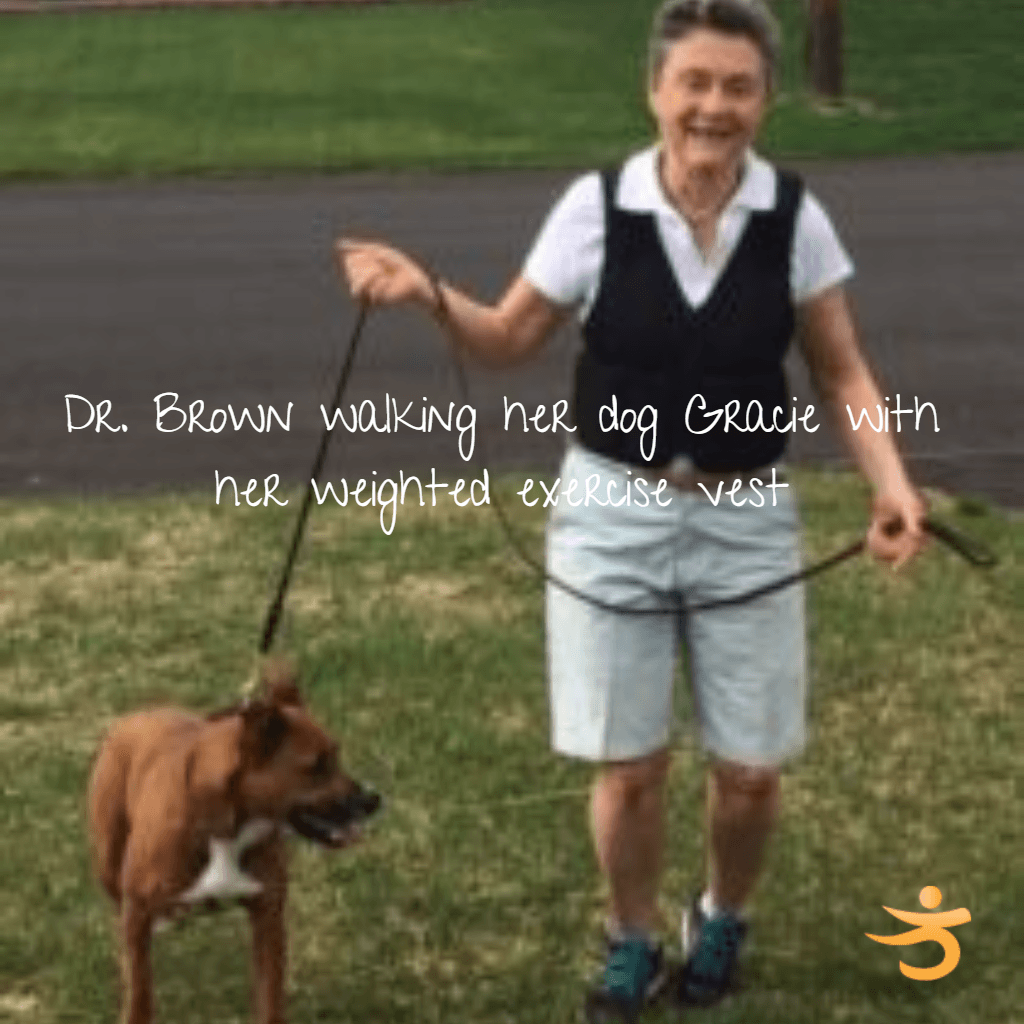
Dr. Brown walking her dog Gracie in her weighted exercise vest: load plus movement, the combination used in the most successful weighted vest osteoporosis study designs.
I favor using the vest during purposeful movement rather than simply putting it on and wearing it for hours. Examples include:
- walking
- stair climbing
- sit-to-stand exercises
- squats or partial squats
- step-ups
- gardening or household movement
- resistance exercise
- heel drops
- and, for individuals who are medically and physically appropriate, small hops or jumps.
The Snow study is especially instructive because the vest was combined with dynamic exercise and jumping.5 The skeletal stimulus came from load plus movement, not from load alone. That distinction may be fundamental.
For more ideas, see my guide to the top exercises for osteoporosis, or join our Better Bones Exercise Evolution program for guided bone-safe workouts, many of them designed for use with a weighted vest.
Who Should Be More Cautious?
Weighted vests are not appropriate for everyone, and heavier is certainly not always better. Extra caution is warranted in people with:
- recent fractures
- painful or unstable vertebral compression fractures
- significant kyphosis
- severe osteoporosis with very high fracture risk
- substantial balance impairment
- serious hip, knee, or spinal disorders
- significant cardiopulmonary limitations
- or other conditions in which additional loading may be unsafe.
In these situations, an individualized assessment by a knowledgeable physical therapist or other qualified clinician is prudent. (If spinal health is your concern, see How to Increase Spinal Bone Density With Exercise.)
The vest should also fit snugly enough that the load remains close to the body’s center of mass. A loose vest that swings or shifts during movement creates a very different mechanical situation from a well-fitted vest.
Choosing a Weighted Vest for Osteoporosis
Because fit and safety matter so much, and because the most successful studies relied on progressive loading, we offer the Better Bones Exercise Vest, a form-fitting, zipper-front women’s vest made in the U.S.A. It comes with 10 pounds of soft, flexible Flex-metal® weights in small half-pound increments, so you can begin at a light load and progress gradually, up to 19 pounds with the optional extra weights. Because the weights are soft rather than hard metal bars, they contour to the body and are gentler should you trip or fall.
Prefer weight at the hips? Read about how weighted vests and weighted belts can help you. And to get started, try our follow-along Get Moving With Your Weighted Vest workout.
Shop the Better Bones Exercise Vest →
Bone Was Designed to Be Challenged
Perhaps the most important lesson of the weighted vest has little to do with the vest itself. It reminds us of something fundamental about the skeleton: bone expects challenge.
Our skeleton evolved in a world of walking, carrying, lifting, climbing, bending, squatting, and occasional impact. Modern life has systematically removed much of that mechanical information.
We sit in cars. We sit at desks. We use elevators. We carry fewer things. We walk on smooth surfaces. We have made life easier for our muscles—and perhaps too easy for our bones.
A weighted vest offers one simple way to restore some of that lost mechanical conversation. The goal is not merely to make ourselves heavier. The goal is to tell the skeleton: You are still needed.
Stay strong.
Frequently Asked Questions About Weighted Vests and Osteoporosis
Does a weighted vest help osteoporosis?
Research suggests it can help when combined with purposeful movement. A 2026 meta-analysis of nine randomized trials found weighted-vest exercise improved femoral-neck and lumbar-spine bone density compared with usual activity, and a five-year study found postmenopausal women using vests plus jumping maintained hip bone density while controls lost bone. Weighted vests are not a proven stand-alone treatment for osteoporosis.
What did the 2025 JAMA weighted vest study find?
Although it is often described as a weighted vest osteoporosis study, the INVEST in Bone Health trial did not specifically enroll people with osteoporosis. The trial (Beavers et al., JAMA Network Open, 2025) found that wearing a weighted vest about seven hours a day did not prevent hip bone loss in 150 older adults losing about 10% of their body weight. Resistance training did not prevent it either. The study tested whether vests could offset weight-loss-related bone loss, not whether vest exercise helps weight-stable women.
What is the most important weighted vest osteoporosis study?
The longest is the five-year study by Snow and colleagues (2000), in which postmenopausal women who exercised three times a week with weighted vests plus jumping maintained hip bone density, while controls lost 3.8–4.4%. The largest body of evidence is the 2026 meta-analysis of nine randomized trials, which found improved femoral-neck and lumbar-spine bone density with weighted-vest exercise.
How heavy should a weighted vest be for osteoporosis?
Start at about 5% of body weight or less (about 6 pounds for a 120-pound woman) and increase gradually toward 10% as strength, balance, and posture allow. Some well-conditioned individuals may progress toward 15%, but that is not a goal for everyone.
How long should I wear a weighted vest each day?
More time is not necessarily better. Passive wear of a light vest for two hours a day without exercise produced no measurable benefit. The research favors wearing the vest during purposeful movement such as walking, stair climbing, sit-to-stands, squats, and step-ups.
Who should not use a weighted vest?
Use extra caution, and seek guidance from a physical therapist or clinician, if you have recent fractures, painful or unstable vertebral compression fractures, significant kyphosis, severe osteoporosis with very high fracture risk, substantial balance problems, serious hip, knee, or spinal disorders, or significant heart or lung limitations.
References
- Frost HM. Bone “mass” and the “mechanostat”: a proposal. Anat Rec. 1987;219(1):1–9. doi:10.1002/ar.1092190104
- Turner CH. Three rules for bone adaptation to mechanical stimuli. Bone. 1998;23(5):399–407. doi:10.1016/S8756-3282(98)00118-5
- Rubin CT, Lanyon LE. Regulation of bone formation by applied dynamic loads. J Bone Joint Surg Am. 1984;66(3):397–402.
- Greendale GA, Salem GJ, Young JT, Damesyn M, Marion M, Wang MY, Reuben DB. A randomized trial of weighted vest use in ambulatory older adults: strength, performance, and quality of life outcomes. J Am Geriatr Soc. 2000;48(3):305–311. doi:10.1111/j.1532-5415.2000.tb02651.x. PMID: 10733058.
- Snow CM, Shaw JM, Winters KM, Witzke KA. Long-term exercise using weighted vests prevents hip bone loss in postmenopausal women. J Gerontol A Biol Sci Med Sci. 2000;55(9):M489–M491. doi:10.1093/gerona/55.9.M489. PMID: 10995045.
- Shaw JM, Snow CM. Weighted vest exercise improves indices of fall risk in older women. J Gerontol A Biol Sci Med Sci. 1998;53(1):M53–M58. doi:10.1093/gerona/53A.1.M53. PMID: 9467434.
- Beavers KM, Lynch SD, Fanning J, Howard M, Lawrence E, Lenchik L, Shapses SA, Weaver AA, Wherry SJ, Zamora Z, Nicklas BJ, Beavers DP. Weighted vest use or resistance exercise to offset weight loss–associated bone loss in older adults: a randomized clinical trial. JAMA Netw Open. 2025;8(6). doi:10.1001/jamanetworkopen.2025.16772. PMID: 40540267.
- Beavers KM, Walkup MP, Weaver AA, Lenchik L, Kritchevsky SB, Nicklas BJ, Beavers DP. Weighted vest use during dietary weight loss on bone health in older adults with obesity. J Osteopor Phys Act. 2017;5(4):210. doi:10.4172/2329-9509.1000210. PMID: 29388604.
- Jessup JV, Horne C, Vishen RK, Wheeler D. Effects of exercise on bone density, balance, and self-efficacy in older women. Biol Res Nurs. 2003;4(3):171–180. doi:10.1177/1099800402239628. PMID: 12585781.
- Klentrou P, Slack J, Roy B, Ladouceur M. Effects of exercise training with weighted vests on bone turnover and isokinetic strength in postmenopausal women. J Aging Phys Act. 2007;15(3):287–299. doi:10.1123/japa.15.3.287. PMID: 17724395.
- Roghani T, Torkaman G, Movasseghe S, Hedayati M, Goosheh B, Bayat N. Effects of short-term aerobic exercise with and without external loading on bone metabolism and balance in postmenopausal women with osteoporosis. Rheumatol Int. 2013;33(2):291–298. doi:10.1007/s00296-012-2388-2. PMID: 22441962.
- Zehnacker CH, Bemis-Dougherty A. Effect of weighted exercises on bone mineral density in postmenopausal women: a systematic review. J Geriatr Phys Ther. 2007;30(2):79–88. doi:10.1519/00139143-200708000-00007. PMID: 18171491.
- Wang X, Zhou L, Shi T, Meng X, Li C, Zhu C, Guo C, Yue C, Tang Y, Liu Y. Effects of weighted vest on bone health and body fat in middle-aged and older adults: a systematic review and meta-analysis. Osteoporos Int. Published online August 14, 2026. doi:10.1007/s00198-026-08196-y. PMID: 42601514.